General Information
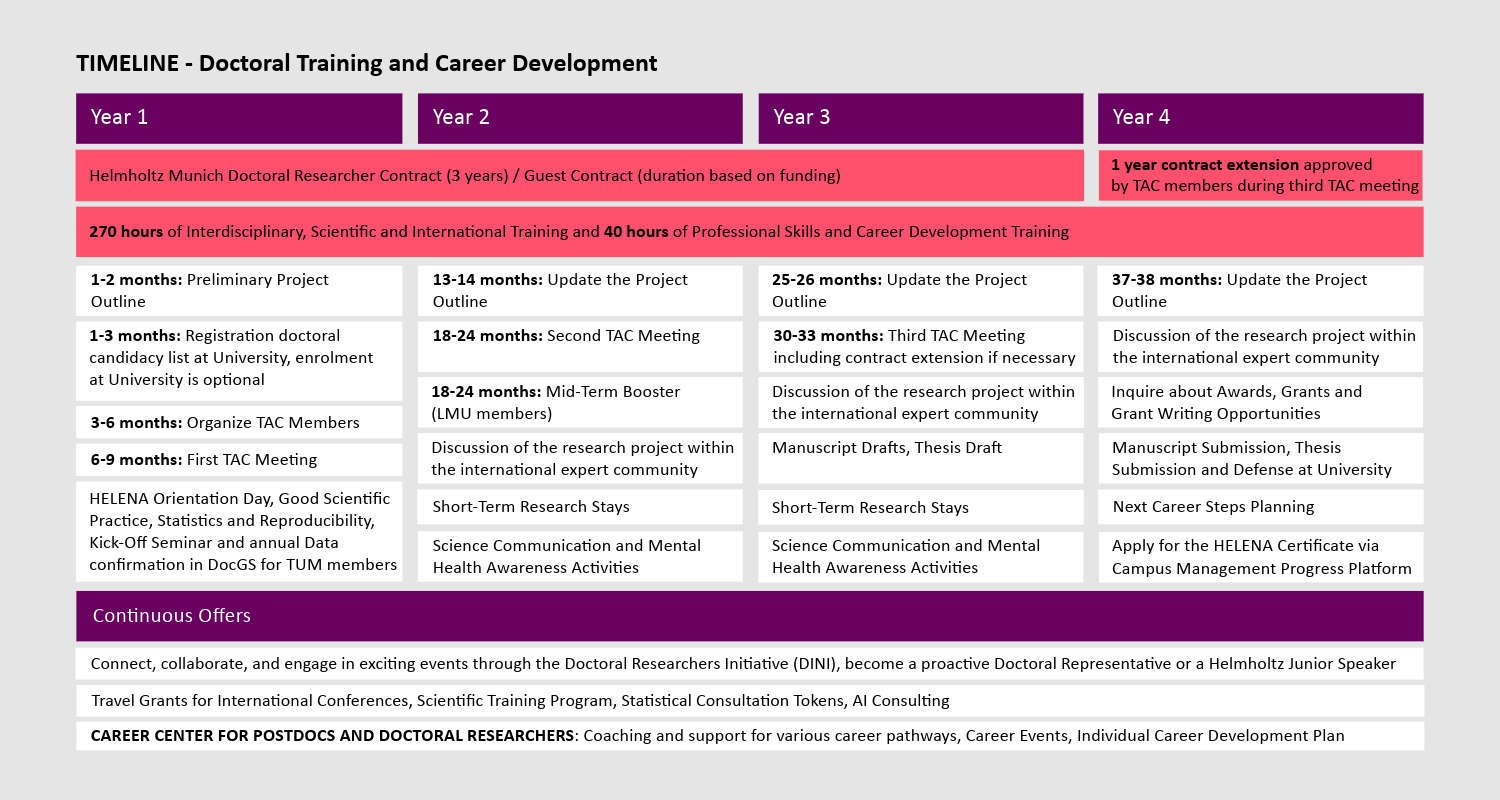
The preliminary project outline form must be filled out in the Progress Platform in agreement with your direct supervisor within 6 weeks of starting your doctoral thesis. The preliminary project outline serves as guidance, elucidates research inquiries, identifies potential challenges and facilitates communication with supervisors. It helps to plan the research project and break it down into manageable tasks, ensuring the project is focused.
The Thesis Advisory Committee (TAC) plays a vital role in guiding and supporting you throughout your thesis journey. Composed of experienced faculty members and experts in the relevant field, the TAC provides valuable feedback, advice, and oversight to ensure the successful completion of the research project. The committee members collaborate closely with you, offering guidance on research methodology, data analysis, and overall project direction. Through regular meetings and constructive discussions, the TAC assists in maintaining high standards of academic excellence and helps you navigate any challenges or obstacles encountered during the thesis process.
For more information, please click here.
University registration is a mandatory requirement to receive your doctoral degree and obtain a final certificate from the Helmholtz Munich Graduate School (HELENA). Consult your supervisor to identify the suitable university and department for your registration. Please register at the university that awards your doctoral degree, within the first three months after starting your doctoral thesis. After your successful registration at the university, we kindly ask you to upload the confirmation to your "Progress Platform".
"Anabin" is an information database of the German Conference of Ministers of Education - Central Office for Foreign Education (Kultusministerkonferenz - Zentralstelle für ausländisches Bildungswesen - ZAB). Its mission is to provide information for the evaluation of foreign educational certificates.
For more information please click here.
Make sure to reconfirm your info in DocGS annually or else your account will be deactivated.
1 term = 6 months (from the starting date of your working contract)
Mandatory elements
- Orientation Days (1 time)
- Statistics and Reproducibility
- Good Scientific Practice
- Kick-off seminar TUM or HELENA Mid-Term Booster LMU
Interdisciplinary, Scientific and International Training: 270 hours
- Journal clubs (1 hour per week/6 terms): 84 hours
- Institute seminars (1 hour per week/6 terms): 84 hours
- 2 method courses (2 times - 3 days): 48 hours
- Introductory seminar (1 hour per week/1 term): 14 hours
- Advanced seminar (1 hour per week/1 term): 14 hours
- Scientific training: 10 hours
- Retreat (2 Days): 16 hours
Professional Skills and Career Development Training: 40 hours
- 3 courses (1 day each): 24 hours
- Interactive Webinars (8 times - 1 hour): 8 hours
- Interactive Workshops (4 times - 2 hours): 8 hours
Mandatory Elements
The HELENA training program comprises a small number of mandatory elements which are recommended within the first year.
HELENA Orientation Day
Participation in the Online Orientation Days (once) is mandatory for all HELENA doctoral researchers
- The event is especially designed for new doctoral researchers and participation within the first year is recommended.
- The program will introduce you to the mission of the Helmholtz Zentrum München and its research programs as well as to core aspects of the HELENA Graduate School and Career Center.
- You will have the possibility to meet the doctoral representatives, learn how to deal with challenging situations and how to make the best out of your PhD.
Good Scientific Practice Workshop
E-Learning Part available in SharePoint
This course is mandatory for all HELENA doctoral researchers. We highly recommend completing this course early in your doctorate journey, as it provides invaluable insights and practical tips for conducting ethical and high-quality scientific research.
Course Structure:
- 9 comprehensive e-learning modules
- Introduction to Good Scientific Practice and Research Integrity
- Misconduct and Sloppy Science
- Plagiarism
- Authorship
- Documentation
- Mentoring and Supervision
- Procedures in case of misconduct
- Research Ethics (Middle position)
- Reproducibility
- A quiz with dilemma game covering all modules
- A supplementary PDF featuring relevant case studies for in-depth discussions
- A 4-hour interactive workshop at Campus Neuherberg
Enrich your doctoral experience by learning the principles of Good Scientific Practice through this thoughtfully structured and mandatory course.
Doctoral researchers who have attended a GSP Workshop at TUM/LMU or externally may be exempt from the Good Scientific Practice (GSP) Workshop upon consultation with the HELENA Team. To validate participation in an external GSP Workshop, kindly submit the following documents to the HELENA Graduate School Office:
- Original course announcement
- Workshop content
- Time spent on the workshop
- Proof of participation
Statistics and Reproducibility
Knowledge in statistics is key for understanding and conducting scientific research. It is essential to have basic statistical literacy in order to design experiments, analyze data and eventually present results and draw reasonable conclusions. Ascertainment of reproducibility is important for evidence-based science and therefore of central concern to all scientists. Therefore, Helmholtz Zentrum München sets new training standards in statistics and reproducibility by introducing mandatory courses for graduate students and postdocs.
The following statistics and reproducibility courses are mandatory for all new graduate students and postdocs who received a working contract from 01.01.2019 onwards and will be accredited with HE points.
It is recommended to first participate in the course "Introduction to R" and afterwards in "Introduction to Statistics" since the exercises of the statistics course require knowledge in R. The course "Reproducible and Open Research" does not depend on participation in the other two courses. It is recommended to participate in all three courses during the first year as a graduate student.
Reproducible and Open Research (credit points: 1 HE)
This course provides a broad overview on different aspects of open research and reproducibility. This includes the fields of technical, statistical and computational reproducibility. The participants will be introduced into principles of open research and state of the art techniques of how to enhance the reproducibility of their research. The course consists of lessons on different aspects of open and reproducible research and offers the opportunity to discuss about experiences and expectations on this topic.
Introduction to Statistics (credit points: 8 HE)
This course combines an overview of basic statistical methods with their application in the statistical software package R. Participants will learn how to perform their data analysis using R and interpret their results in a meaningful way. The course covers basic statistical methods, such as descriptive statistics, hypothesis testing, linear regression, and ANOVA. This course does not require any previous knowledge in statistics. However, basic skills in R programming are a prerequisite for the course and can be achieved in the course "Introduction to R".
Introduction to R (credit points: 4 HE)
Statistical analysis can be performed by using a script-based software, which guarantees the traceability and reproducibility of the analysis. The software R is optimal for this, since R provides access to a very broad range of (up-to-date) statistical methods and is also open source. Furthermore, R is the dominating programming language for statistical analyses in academia and is also widely used in industry.
In this course, the participants will be taught how to get started with the statistical software package R and will achieve a basic understanding of how R is working. The course covers basic data structures and routines, such as dealing with vectors, matrices and datasets, and does not require any previous knowledge of statistics or programming. The course consists of lessons how to use R and of hands-on examples with best-practice solutions.
For graduate students who already have appropriate programming skills and/ or knowledge in statistics, mandatory participation in the statistics courses ("Introduction to R" and "Introduction to Statistics") may be waived after consultation with the Core Facility Statistical Consulting. For additional information, please click here.
Participating in the TUM-GS Kick-Off Seminar is mandatory for all TUM-affiliated HELENA doctoral researchers. To benefit the most from the Kick-Off Seminar, participation is strongly recommended within the first six months after the start of your doctorate. Furthermore, Kick-Off Seminar participation is a prerequisite for access to the TUM-GS internationalization support.
For further information please click here.
Participating in the Mid-Term Booster GraduateCenterLMU is mandatory for all LMU-affiliated HELENA doctoral researchers and is recommended within the second year. The registration link will be announced in the Newsletter.
Travel Grant
To be eligible for a HELENA travel grant, you must have participated in the HELENA Orientation Day and had your first Thesis Advisory Committee (TAC) meeting. Ensure that the TAC documentation is completed on the Progress Platform. Travel grant applications must be submitted on the Progress Platform a minimum of 4 weeks before your intended travel date. Remember to complete the Business Trip Form in SPIT to apply for a HELENA Travel Grant.
HELENA funds active participation at international conferences with up to 1.500 € per doctoral researcher. HELENA also covers registration costs for conferences which are taking place online. Please note that you still have to fill out the Business Trip Form in SPIT, and mention ONLINE Conference in the space provided for justifying your Business Trip.
HELENA may reimburse non-refundable expenses caused by conference cancellations, quarantine orders etc. as part of the internationalization support. However, costs reimbursed will be reduced from the internationalization budget.
HELENA supports active participation (poster or talk) of its members at research stays abroad with up to 3.000 €. Doctoral researchers can apply for a research stay abroad only one time. If the number of applications is very high, HELENA reserves the right to award the funding for research stays in a competitive manner. Currently, due to the financial situation at the Center, travel grants for research stays and summer schools will continue to be suspended until further notice.
Publications
A temporary version of the EVA request can be found in SharePoint: EVA form. Please use it to request new publications until the PuSH server is available again.
For the reimbursement of Open Access publications, please first create an EVA request. Then you can submit your request together with the invoice to astrid.uerlichs@helmholtz-munich.de.
Access to subscription journals or information portals is only possible from the campus network.
After you have successfully defended your Thesis at the University, please submit your final Thesis to library@helmholtz-munich.de.
HELENA Certificate and Doctoral Researcher Award
Upon completing the HELENA training program and your doctoral defense at the University, you will receive the HELENA certificate. Remember to submit the doctoral completion form in your progress platform after defending your thesis at the University. Update your contact info with your private email before your contract ends for uninterrupted CaMS access.
The Doctoral Researcher Award has been launched to recognize the outstanding scientific achievements and exceptional commitment of doctoral researchers in science. Supported by the Helmholtz Munich Graduate School (HELENA), the Association of the Friends and Supporters of Helmholtz Munich (VdFF), and Stiftung AtemWeg, the award will be granted annually to two outstanding dissertations, each endowed with a certificate and € 2,500.
Dissertations may be submitted only once for consideration in the doctoral researcher award competition. The application period is scheduled to run from late February to early May.
Continuous Offers
Are you a newcomer at Helmholtz Munich and looking for assistance to settle into your new life at the Center and in Munich? If so, we encourage you to reach out to the DINI team. They organize various activities for the doctoral researchers' community, maintain regular communication with the HELENA Graduate School Office and management, and provide valuable information for doctoral researchers at Helmholtz Munich. Furthermore, you can always contact the team with any questions or requests for assistance by sending an email to doktorandeninitiative@helmholtz-munich.de. We are currently searching for new doctoral representatives, if you are interested please send an email to helena@helmholtz-munich.de.
Unlock your potential with our exciting training sessions, captivating webinars, and thought-provoking talks hosted by the Scientific Talent and Career Development Team. Do you have questions or seeking more information about our training opportunities? Contact Mirjam Lober at scientific-training@helmholtz-munich.de and explore our courses in the course overview!
A comprehensive offer tailored exclusively for doctoral researchers seeking specialized statistical help. Through this fully funded offer by HELENA, eligible doctoral researchers are granted three one-hour consulting tokens for one-on-one consultations with experienced statisticians at the Core Facility Statistical Consulting.
This flexible framework enables doctoral researchers to obtain statistical support when needed, hence optimizing research quality.
Helmholtz AI is not only a platform for scientists doing their own research. Helmholtz AI consulting empowers all researchers from the Helmholtz Association to leverage AI methods and expertise for their datasets. The Helmholtz AI consultant teams can provide support with their deep expertise in AI methods, tools and software engineering for research projects. Working with the consultants comes at no cost, as collaborations are entirely scientific.
The Helmholtz AI voucher system serves as a flexible, dynamic and transparent way to set up collaborations with the Helmholtz AI consultants at all six Helmholtz AI units.
For more information click here.
Our Career Center is dedicated to assisting you in exploring and pursuing a wide range of career paths, both within and beyond academia. They provide a range of resources, services, workshops, career talks and personalized coaching sessions that are specifically tailored to meet your individual needs. Their goal is to support your professional development, enhance your skills, and ultimately improve your employability prospects.
Further Offers at Helmholtz Munich
At Helmholtz Munich eight core facilities support and enable more than 1,500 scientists working together to discover personalized medical solutions for environmentally triggered diseases.
For further information please refer to their website.
The Project Funding Team within the department Strategy, Programs, Resources (SPR) is responsible for the efficient handling of the project application and supporting the principal investigators. Project Funding is the official contact point for your project application and guides you through the process with the checklist for quality assurance.
One important focus of their work is the organisation of courses with internal and external trainers on funding opportunities and proposal writing. Please refer to the course overview for third-party funding training offers.